


Architectural and design students from around the world are invited to enter the Ecohouse Student Design Competition 2008. The competition invites designs for an ecohouse of 120m2 for up to six persons on a plot of 200m2. It will be launched at the forthcoming Ecobuild by The Concrete Centre, in conjunction with the Architectural Press and Teachers in Architecture.
The designs should take full account of how to reduce energy needs for heating, cooling and lighting, the use of passive sustainability techniques, and the use of local construction materials and renewable energy sources. In addition, the homes must be designed to be robust and resilient and last until at least the end of this century and through an age of increasingly extreme weather events. Whilst taking account of all of these criteria, the homes must also be designed for comfort and lifestyle flexibility.
Total prize fund is £3,500
Steve Elliott, Construction Dialogue, tel: 01276 36735, email: condialogue@aol.com
Entries must be received by 22 June 2008. For further information and registration visit: www.concretecentre.com
Thursday, 21 February 2008


Wednesday, 20 February 2008
Architecture !!!!


The comic is about the life of an architect by the name of Archibald and the things that cross his path.
Archibald runs an architecture office together with his colleague and friend, the engineer Gerald. They are partners for life. Despite their completely different personalities, they complement each other perfectly. While Archibald is a dreamer, the man with the big ideas, Gerald is the realist who keeps his feet firmly on the ground.
Archibald is an egocentric idealist with his very own views on architecture. His often vehement clashes with the various participants in the building process are the living proof of that. However, he gradually realizes that it is sometimes necessary to compromise when you want to see your projects substantiated.
He understands that architecture is more a quest than a standing fact. He pursues a future as an architect, but preferably in a limitless universe where he can do whatever he likes
This cartoon shows how Archibald thinks, feels and looks at the world and the people on it, focusing on the struggle with himself, his emotions and his burning need for recognition.
Every one of us follows his own path in order to learn the things of life. Architecture is Archibald’s path to human learning.
Tuesday, 19 February 2008
Socially acceptable design


FXFOWLE ARCHITECTS has unveiled its design for a new socially, economically, and environmentally sustainable housing project planned for a growing region in Greater Noida, India. Located 48 km (30 miles) from Delhi in Northern India and near a major regional rail system, Greater Noida will provide 1,700 units of housing (studios to five bedrooms) and 3,700 units of parking for a growing Indian middle-class. Situated on a 19-hectare (47-acre) site, the Greater Noida Housing Project is developed by Ansal Properties & Infrastructure, a commercial and residential real estate company with offices throughout India. Situated on a 19-hectare (47-acre) site, the Greater Noida Housing Project is developed by Ansal Properties & Infrastructure, a commercial and residential real estate company with offices throughout India. The project is currently in design development with an anticipated completion in 2011. The project's twenty-two residential buildings are clustered throughout the site with varying heights. The taller structures (from 25 to 45 stories) are located on the northern edge of the site, and the smaller buildings (from 5 to 15 stories) are layered to the south. The varying building heights and lengths create a vibrant, urban rhythm to the site development. The buildings are an interplay of solid and voids, rectilinear volumes stacked, shifted, and stacked again, with residential units interspersed with cultural and amenity space floating above the rolling site. The architecture is created using a modular system of residential unit types supported by concrete sheer walls and flat slabs. This structural system allows for residential units with column-free living spaces and dual exposures. The shear walls are clad in terra cotta, responding to the color and texture of the environment. Balconies, terraces, outdoor seating, and gardens extend the residential units into the natural environment to encourage social interaction and at the same time reinforce the privacy of the residential units.
Symbol of prosperity and pride for India- Construction starts on FXFOWLE's 60 storey tower in Mumbai


Construction has started on India Tower, a new 60-storey (301 meters) world-class hotel, retail, and residential tower designed by FXFOWLE ARCHITECTS, an internationallyrecognized architecture firm with offices in New York City and Dubai. Located in South Mumbai, India, and developed by D B Hospitality Private Limited, India Tower combines architectural design excellence, environmental responsibility, and high-end shopping, dining, and entertainment options to create a dynamic new destination for local residents and international business and leisure travelers. The developer is committed to making India Tower a United States Green Building Council (USGBC) LEED Gold-rated project, setting a high standard for future architecture and design projects in the country. Construction is expected to be completed in 2010.
"Our approach to designing India Tower centered on creating a premier international hotel, retail, and residential tower within India’s emerging new economy," stated Sudhir Jambhekar, AIA, LEED, Principalin- Charge of FXFOWLE's International Studio in New York City. "The tower’s architecture is timeless and prominent with a design that respects India’s rich history, but looks to the future. Once complete, India Tower will be a new symbol of prosperity and pride for the country.”
India Tower is located in the prestigious South Mumbai coastal area fondly referred to as the Queens Necklace. The tower’s rotated form emerges in response to the 3-acre (1.2-hectares) site, the building’s functional requirements, and its mixed-use program that changes with each rotation of the tower. This circulation pattern separates retail, a custom-designed residential-style Park Hyatt hotel and serviced apartments, and long-lease and duplex penthouse condominium apartments within a sustainable network of green roofs and hanging gardens to create a singular, landmark building with panoramic views of South Mumbai and the Arabian Sea.
The design concept for India Tower was informed by Mumbai’s climate, the site, and the desire to create distinctive indoor and outdoor spaces with optimum views, inspirational settings, and personalized contemporary accommodations for all users. Designed to have the least possible impact on the environment, the tower will integrate current innovative sustainable systems and technologies throughout the building – solar shading, natural ventilation, daylighting, rainwater harvesting, and green interior finishes and materials – to make it one of the greenest skyscrapers in India.
India Tower’s 3-story podium will include restaurants and cafés, luxury-brand retail stores, a health/fitness club with a swimming pool, and a nightclub/lounge. The podium’s light-colored granite, glass, and stainless steel design complements the tower’s upper floor facades, which are a combination of off-white aluminum panels and insulated glass operable windows. Sited under the podium are three levels of below-grade parking for 650 vehicles as well as designated retail and hotel service functions.
The Park Hyatt hotel, known for first-class locations and accommodations, will brilliantly combine elegance and dramatic architecture to provide cultivated travelers privacy, personalized service, exclusive spa and dining experiences, and impeccable quality during their stay. When arriving at India Tower, Park Hyatt guests will be directed to the Sky Lobby (levels 30-35) to check-in, then descend to levels 14 through 28 to their hotel residences. Each hotel residence level will have 10 to 11 guest rooms, all with spectacular western views of the Arabian Sea. Levels 5 to 12 will feature three Park Hyatt hotelserviced apartments per floor.
India Tower’s long-lease apartments will be located on levels 38 through 50, and will feature stylish and spacious two-story living spaces that have been specially designed to take full advantage of the expansive views from this height. Levels 52 to 59 of the tower will house one-of-a-kind duplex penthouse condominium apartments with unparalleled panoramic views. The upper floors of these remarkable apartments will turn along an internal staircase to allow for multiple views and a 360-degree perspective of South Mumbai and the Arabian Sea.
A glimpse into the design and interior of The Times building


At the end of last year, The New York Times Company officially opened its new headquarters building in the heart of Times Square. The 52-story glass and steel structure, designed by Renzo Piano and FXFOWLE and interiors designed by Gensler, reinforces the values of the Times Company and its culture of transparency. With floor to ceiling water-white glass windows, exposed steel columns and accents of red and marigold, the building is a fitting home for a 21st-century media company.
Monday, 18 February 2008

Friday, 15 February 2008
Architectural Presentation - Art nouveau
Art nouveau
International style of decoration & architecture developed in1880
name derives from the maison de l” art nouveau gallery opened in paris 1896
The movement was also assosiated with arts & craft
Architect – charles rennie mackintosh

Work -
Glass gow school of art – scotland
Hillhouse – at helensburg, scotland
The willow tea rooms – scotland
Born in glassgow , scotland in 1868
Won the travelling scholership in 1890 before setting into practice
Outstanding architect , furniture designer & painter
Brief about hillhouse
Location – helensburg , scotland
Year – 1902 – 1903
Style – art nouveau
Built from local sandstone & rough cast rendered , scottish baronial tradition
Built in wordrobes , walls in white with delicate stencil design in pale green,pink &silver
Strethes west to east


Artist – alphonse mucha
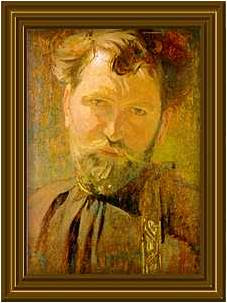
Born in 1860 inivancice , maravia
A well known painter
His concept of painting was based on strong composition , curves derived from nature, refined decorative elements and natural colours
He started practice in england by designing
Campagne advertisement & stage sets
Become famous during worlds fair in paris in 1890 when he designed the bosnia – hercegovina pavallion
He worked in america also
He died in 1939
Painting of alphonse mucha


Architect – antoni gaudi
Famous spanish architect
Born on june 25 ,1852 in reus , catalonia
Status is due to his capacity for synthesizing tradition & andacity of his technical solutions as well as his use of brilliant , unique & creative ornamentation
Graduated in barcelona in 1878
His first imp. Job was casa vicens in barcelona (1883 – 1888)
Casa milla was also one of imp. Job (1904-1906)
Died in 1926
Brief about casa mila
It is also known as la pedrera , an appartement building situated at passeig . De gracia no.92 in barcelona built between 1906-1910, for the mila family
Last example of civil architecture
Gaudi’s finest & most ambitiuos creation , extraordinarily innovative in its functional , contructive , ornamental aspects
The façade is an impressive wave like mass of rough-clipped stone
It has unique roof formed of lofts over the frame of a series of parabolic arches of varying height with marble mansard brokenonly by small windows
This plan completely broke away from the other buildings in that district.


International style of decoration & architecture developed in1880
name derives from the maison de l” art nouveau gallery opened in paris 1896
The movement was also assosiated with arts & craft
Architect – charles rennie mackintosh

Work -
Glass gow school of art – scotland
Hillhouse – at helensburg, scotland
The willow tea rooms – scotland
Born in glassgow , scotland in 1868
Won the travelling scholership in 1890 before setting into practice
Outstanding architect , furniture designer & painter
Brief about hillhouse
Location – helensburg , scotland
Year – 1902 – 1903
Style – art nouveau
Built from local sandstone & rough cast rendered , scottish baronial tradition
Built in wordrobes , walls in white with delicate stencil design in pale green,pink &silver
Strethes west to east


Artist – alphonse mucha

Born in 1860 inivancice , maravia
A well known painter
His concept of painting was based on strong composition , curves derived from nature, refined decorative elements and natural colours
He started practice in england by designing
Campagne advertisement & stage sets
Become famous during worlds fair in paris in 1890 when he designed the bosnia – hercegovina pavallion
He worked in america also
He died in 1939
Painting of alphonse mucha


Architect – antoni gaudi
Famous spanish architect
Born on june 25 ,1852 in reus , catalonia
Status is due to his capacity for synthesizing tradition & andacity of his technical solutions as well as his use of brilliant , unique & creative ornamentation
Graduated in barcelona in 1878
His first imp. Job was casa vicens in barcelona (1883 – 1888)
Casa milla was also one of imp. Job (1904-1906)
Died in 1926
Brief about casa mila
It is also known as la pedrera , an appartement building situated at passeig . De gracia no.92 in barcelona built between 1906-1910, for the mila family
Last example of civil architecture
Gaudi’s finest & most ambitiuos creation , extraordinarily innovative in its functional , contructive , ornamental aspects
The façade is an impressive wave like mass of rough-clipped stone
It has unique roof formed of lofts over the frame of a series of parabolic arches of varying height with marble mansard brokenonly by small windows
This plan completely broke away from the other buildings in that district.


Thursday, 14 February 2008
Architectural Presentation - ARCHITECT BURLE MARX
ABOUT THE ARCHITECT

Roberto Burle Marx was born in the city of Sao Paulo in Brazil on 4 august 1909.
He learned various languages such as potuguese, german, french, english, spanish and italian fluently.
Since childhood he was interested in music and play.
He was a painter, poet and musician along with landscape designer.

A local brazilian woman

Mangroove plantations

A drawing in India ink
In his initial paintings his subject was the focal point just as it had been in his gardens.But during 1940’s, his attention was shifted frpm narrative to purely visual
Later in his paintings he abstracted pictoral forms from the real one.
Eg :In the adjoining painting the complex lines that indicate ambiguous anatomical contours.
DURING HIS TIME
Burl Marx family arrived in Europe during the period of great change
In the year 1928the battle of modernism was waged. It was an essential urban phenomenon thriving on a period of relative peace and economic progress.
Photography became an art form in these years which helped to emphasize on light.
In the year 1927saw the inauguration of a department of architecture directed by Walter Gropius at the Bauhaus.
The art historian Sigfried Giedion founded CIAM(the international congress of modern architecture) in Swizerland in the year 1928
LANDSCAPE


Italian gardens
Burle Marx’s gardens were described as paintings by the critics.
His works are diverse and prolific due to the fact that he was a landscape designer, poet musician and painter and painting, sculpture and architecture all came in his gardens together.
The classical gardens have a extreme geometry, its forms opposing those of nature.

By contrast English gardens aims to reproduce nature so that all the artifice are hidden.
He paid particular attention to the geographical and topographical features.
Burle Marx created his gardens with the idea that his involvement should go unnoticed.
For example he may divert a river so that it looked as if it had always flowed that way.
Nevertheless his style and imprint were always unmistakable.
He worked with the colors and textures of foliage to achieve a more intense, contrasting and durable effect.
Burle Marx’s composition also has affinities with Chinese and Japanese gardens, using resources economically, making the most of the texture of minerals, the sculpted shapes of stones, the blooms, etc.
His paintings are gardens where the spirits wander, just as his gardens are drawings where nature takes shape.
PHILOSOPHY
A garden, is organized nature, where the artist aims to bring out the beauty of the colours, the forms, the rhythm, the ordered volumes.It is the establishing of harmony, the creating of contrasts, since the whole is warp and weft in which every element is indensible.
He found his inspiration in the natural world because it offered him purity of non narrative forms.

Garden at Vargem Grande Fazenda, during construction phase
To create a sense of unity between the garden and its surroundings. To interpret the essence of the place, extract its character and make it more expressive, highlighting the intrinsic beauty of the scenery so that it serves as a exterior backdrop.
GARDENS ALONG THE SEAFRONT
Praca Senador Salgado Filho
Gardens of the museum of modern art
Gardens of the Monument to the Fallen of World War 2
Aquarium and the Marina da Gloria
Outerio da Flamengo
Parque do Flamengo
Morro da Viuva restaurant
Praca Indigo Cauhtemoque
Leme, Parca Almirante Julio de Noronha
Copocaba promenade
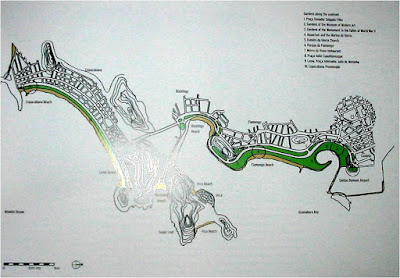
Parque do Flamengo(1961-65)
Located in Attero Gloria Flamengo- Rio de jeneiro.
Area 1,20,00,000 sq m
In this project a highway was to be provided on narrow strech of coast between the hills and the sea.
The plan was designed by a working group of botanists, engineers and architects.

plan

Bird’s eye view of the area
They had to envisage not only a two speed highway with pedestrian crossings at various levels but also areas designated for recreational activities.
Various stages were designed for music and theatre, tree lined car parks, areas for picnicking, relaxing and playing games


The shady trees and bushes along the paths protect the winds
The zone near the sea slopes down to an artificial beach where the rows of palm trees punctuate the space.
The plant selection was based on blocks of the same species arranged in a harmonious composition of solid and voids.
Largo da carioca (1981-85)

Situated in Rio de janeiro.
Area 2 hectares.
The Largo da Carioca is a giant abstract picture designed to be viewed from the surrounding buildings.
It acts as a focal point for all the converging gardens in the area.
The design was worked around the existing elements in the square – a fountain, a clock tower, ventilation ducts using red, white and black Portuguese stone,grass and water.


Metropolitan cathedral (1968)

It is located in Rio de jeneiro.
The church is a circular structure in the center of sight.
There are four pools ringed with benches and the paving patterns echo the circular shape of the structure.
A large mass of bauhinea orchids climbs the sides of the steps to the main entrance in staggered planters.This is the only part of the scheme to have been realized.
Currently the area is used as car park

Roberto Burle Marx was born in the city of Sao Paulo in Brazil on 4 august 1909.
He learned various languages such as potuguese, german, french, english, spanish and italian fluently.
Since childhood he was interested in music and play.
He was a painter, poet and musician along with landscape designer.

A local brazilian woman

Mangroove plantations

A drawing in India ink
In his initial paintings his subject was the focal point just as it had been in his gardens.But during 1940’s, his attention was shifted frpm narrative to purely visual
Later in his paintings he abstracted pictoral forms from the real one.
Eg :In the adjoining painting the complex lines that indicate ambiguous anatomical contours.
DURING HIS TIME
Burl Marx family arrived in Europe during the period of great change
In the year 1928the battle of modernism was waged. It was an essential urban phenomenon thriving on a period of relative peace and economic progress.
Photography became an art form in these years which helped to emphasize on light.
In the year 1927saw the inauguration of a department of architecture directed by Walter Gropius at the Bauhaus.
The art historian Sigfried Giedion founded CIAM(the international congress of modern architecture) in Swizerland in the year 1928
LANDSCAPE


Italian gardens
Burle Marx’s gardens were described as paintings by the critics.
His works are diverse and prolific due to the fact that he was a landscape designer, poet musician and painter and painting, sculpture and architecture all came in his gardens together.
The classical gardens have a extreme geometry, its forms opposing those of nature.

By contrast English gardens aims to reproduce nature so that all the artifice are hidden.
He paid particular attention to the geographical and topographical features.
Burle Marx created his gardens with the idea that his involvement should go unnoticed.
For example he may divert a river so that it looked as if it had always flowed that way.
Nevertheless his style and imprint were always unmistakable.
He worked with the colors and textures of foliage to achieve a more intense, contrasting and durable effect.
Burle Marx’s composition also has affinities with Chinese and Japanese gardens, using resources economically, making the most of the texture of minerals, the sculpted shapes of stones, the blooms, etc.
His paintings are gardens where the spirits wander, just as his gardens are drawings where nature takes shape.
PHILOSOPHY
A garden, is organized nature, where the artist aims to bring out the beauty of the colours, the forms, the rhythm, the ordered volumes.It is the establishing of harmony, the creating of contrasts, since the whole is warp and weft in which every element is indensible.
He found his inspiration in the natural world because it offered him purity of non narrative forms.

Garden at Vargem Grande Fazenda, during construction phase
To create a sense of unity between the garden and its surroundings. To interpret the essence of the place, extract its character and make it more expressive, highlighting the intrinsic beauty of the scenery so that it serves as a exterior backdrop.
GARDENS ALONG THE SEAFRONT
Praca Senador Salgado Filho
Gardens of the museum of modern art
Gardens of the Monument to the Fallen of World War 2
Aquarium and the Marina da Gloria
Outerio da Flamengo
Parque do Flamengo
Morro da Viuva restaurant
Praca Indigo Cauhtemoque
Leme, Parca Almirante Julio de Noronha
Copocaba promenade

Parque do Flamengo(1961-65)
Located in Attero Gloria Flamengo- Rio de jeneiro.
Area 1,20,00,000 sq m
In this project a highway was to be provided on narrow strech of coast between the hills and the sea.
The plan was designed by a working group of botanists, engineers and architects.

plan

Bird’s eye view of the area
They had to envisage not only a two speed highway with pedestrian crossings at various levels but also areas designated for recreational activities.
Various stages were designed for music and theatre, tree lined car parks, areas for picnicking, relaxing and playing games


The shady trees and bushes along the paths protect the winds
The zone near the sea slopes down to an artificial beach where the rows of palm trees punctuate the space.
The plant selection was based on blocks of the same species arranged in a harmonious composition of solid and voids.
Largo da carioca (1981-85)

Situated in Rio de janeiro.
Area 2 hectares.
The Largo da Carioca is a giant abstract picture designed to be viewed from the surrounding buildings.
It acts as a focal point for all the converging gardens in the area.
The design was worked around the existing elements in the square – a fountain, a clock tower, ventilation ducts using red, white and black Portuguese stone,grass and water.


Metropolitan cathedral (1968)

It is located in Rio de jeneiro.
The church is a circular structure in the center of sight.
There are four pools ringed with benches and the paving patterns echo the circular shape of the structure.
A large mass of bauhinea orchids climbs the sides of the steps to the main entrance in staggered planters.This is the only part of the scheme to have been realized.
Currently the area is used as car park


